
Last Updated on October 13, 2026 by Michael Smith
Every office has one. A door at the end of the hallway that hums, runs cold enough to chill a six-pack, and has a handwritten sign taped to it that reads “DO NOT UNPLUG ANYTHING.” Maybe it’s a full server room. Maybe it’s a converted supply closet with a router, a tangle of cables, and a box fan someone brought from home in 2019.
Either way, it makes people nervous. Cleaning crews included.
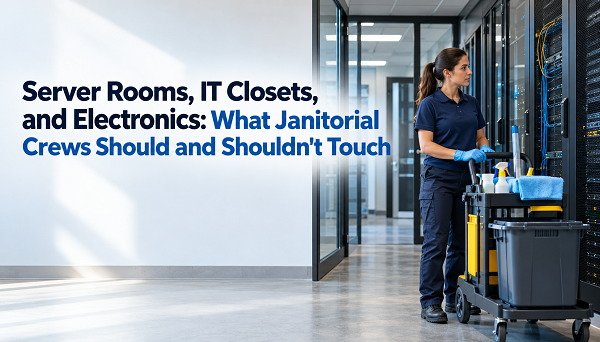
That nervousness is healthy. Our team has spent years cleaning offices, medical suites, and commercial buildings across Tucson, and the IT closet is one place where “be thorough” takes a back seat to “be careful.” Here’s how a good crew handles it, and what you should expect from whoever you hire.
Why the Humming Room Gets Special Treatment
Think about what lives in there. Your email, your phone system, your security cameras, possibly your entire customer database. One bumped power strip on a Tuesday night can mean a very long Wednesday morning for your office manager.
And here in the desert, there’s a second villain: dust. Tucson air carries fine particulate year-round, and it loves to settle into equipment vents. Buildings already struggling with ventilation issues benefit from janitorial plans targeting persistent dust, especially when outdated HVAC systems allow particles to accumulate. Dust buildup makes servers run hotter, and heat shortens the life of expensive hardware. So the room does need cleaning. It just needs the right kind.
The Hands-Off List
Before our crew sets foot in a new client’s IT space, we agree on boundaries. These precautions are part of the same approach we use for nightly cleaning in restricted areas, where protecting sensitive information and maintaining controlled access are just as important as keeping the space clean. Most of the boundaries look something like this:
- Anything plugged in stays plugged in. No unplugging, even “just for a second” to run a vacuum. Same goes for power strips, battery backups, and those mystery cords nobody can identify.
- No liquids near equipment. That means no spray bottles aimed at racks, keyboards, or monitors. Cleaner gets applied to a cloth first, never directly to a surface.
- Racks and cabinets stay closed. If the doors are shut, they stay shut. Interior cleaning of equipment is a job for your IT people, period.
- Cables are not tidied. It might look like spaghetti. It might be very intentional spaghetti.
- Thermostats and cooling units are left alone. That room is cold on purpose.
- Nothing gets moved. Not a box, not a laptop on the floor, not a monitor stand.
So What Actually Gets Cleaned in There?
Plenty, honestly. The trick is technique.
Floors come first. Many server spaces have sealed concrete, vinyl tile, or raised flooring, which all fall under hard floor cleaning, but with a twist. Wet mopping is out. Our crews use a lightly dampened microfiber mop or a HEPA-filtered vacuum, which traps fine dust instead of blowing it back into the air (and into your equipment intakes).
What about carpet? Smaller IT closets sometimes sit on carpet, which introduces static. Commercial carpet maintenance in these spots means regular vacuuming to keep dust levels down, plus caution with extraction. Nobody wants a damp carpet next to a network switch.
Exterior surfaces get a dry microfiber wipe. Door handles, light switches, and the tops of desks or shelving outside the rack area get the same attention as anywhere else in the building. Trash goes out. Cardboard boxes from new hardware deliveries? We ask before tossing, since someone may need that box for a warranty return.
Desks Full of Gadgets? Same Rules, Smaller Scale
Your regular office cleaning covers far more electronics than the server room ever will. Every workstation has a monitor, a keyboard, a phone, maybe a docking station that took IT forty minutes to configure.
Good janitorial services treat these like mini server rooms. Screens get wiped with a dry or barely damp cloth made for displays. Keyboards get a gentle surface pass. Sticky notes stay exactly where they were, because that might be someone’s only record of a password reset (we’re not judging).
A day porter can be a big help here. Having someone on-site during business hours means spills near computers get handled right away, before coffee finds its way into a laptop. The same “cloth first, never spray” rule applies to window washing near desks, too. Overspray drifts, and it drifts right onto keyboards.
Starting With a New Crew: What Happens First
So you’re considering a new janitorial company in Tucson. What does the first month look like?
It starts with a walkthrough. We tour your space with you or your facilities contact and specifically ask about IT areas. Which rooms are off-limits? Which need light cleaning only? Who holds the keys, and does entry need to be logged?
From there, you get a written scope of work that spells out exactly what happens in sensitive rooms, how often, and with what equipment. Crews get trained on your site before their first shift. And after a couple of weeks, we check back in to ask what’s working and what needs adjusting.
Wondering what to ask any company you’re interviewing? Try these. Do your crews get site-specific training for IT spaces? Do you use HEPA vacuums? Is there a supervisor who checks the work? Will the same team show up each night? If the answers come back vague, keep looking.
Tucson’s Best Janitor Service Knows When to Back Away
Here’s what we believe: the best janitorial crew is one that knows the limits of its job. Clean floors, dust-free surfaces, and a server room nobody worries about. That’s the goal every single night.
Southwestern Building Maintenance has earned a reputation as the best janitor service in Tucson, Arizona by paying attention to details like these, from hard floor cleaning and commercial carpet maintenance to day porter coverage and window washing. If your building has a humming room at the end of the hall, give us a call. We’ll walk it with you, figure out the ground rules together, and leave the blinking lights exactly as we found them.